Vineet Suthan Breaks the rules of the game

Wednesday, July 27, 2005

More pictures On mumbai floods
latest:
Image hosted by Photobucket.com

Image hosted by Photobucket.com

Image hosted by Photobucket.com

Image hosted by Photobucket.com

Image hosted by Photobucket.com

Image hosted by Photobucket.com

Image hosted by Photobucket.com

Bombay Monsoon
Maharashtra monsoon 'kills 100'
Rains beat Cherrapunji record :
Mumbai today:94.4 centimeters (37.1 inches) in one day in suburban Mumbai
Cherrapunji:3.82 centimeters (33 inches) on July 12, 1910

Image hosted by Photobucket.com

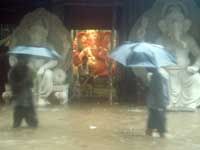
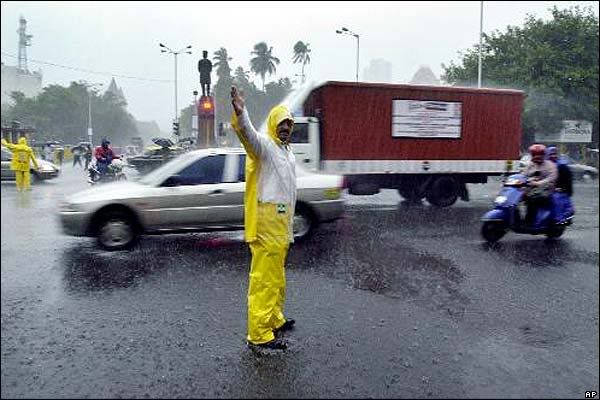
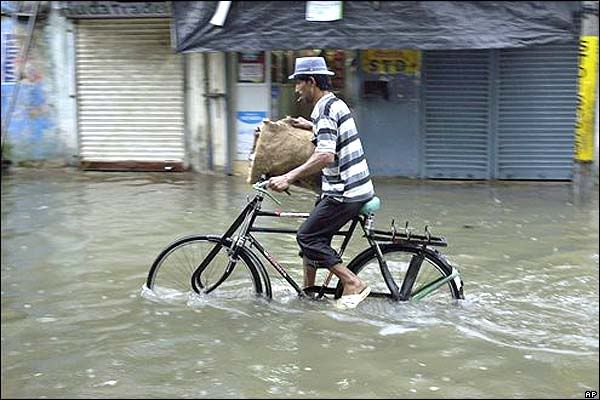
The strongest rains ever recorded in India shut down the financial hub Mumbai today, snapped communication lines, closed airports and marooned thousands of people, according to officials.

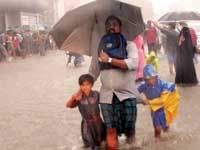
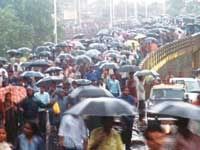
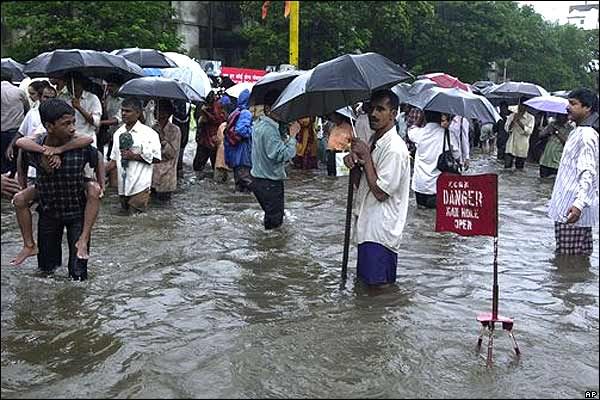
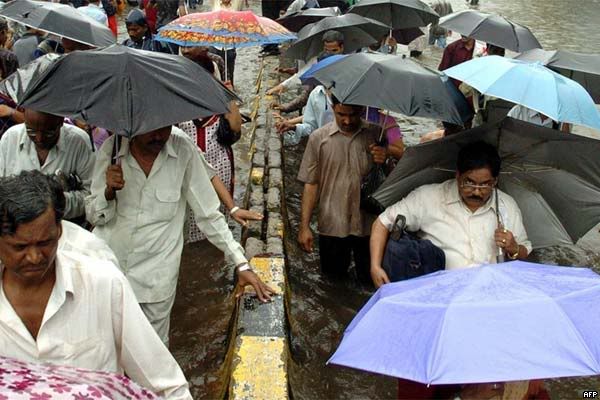
Commuters struggle to work on Wednesday
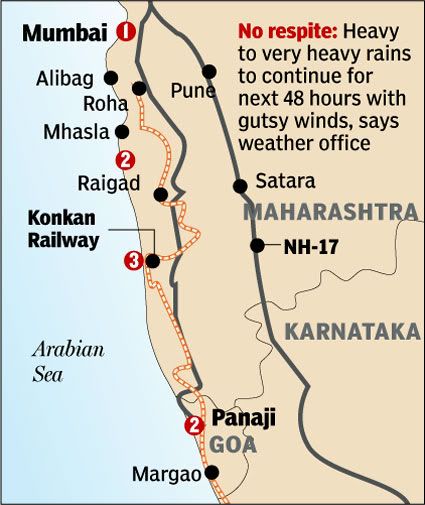
Monsoon rains are continuing to cause havoc in India's Maharashtra state where the official death toll has now risen to nearly 100.
The state's chief minister says Tuesday's rain was the heaviest recorded in a single day in India.

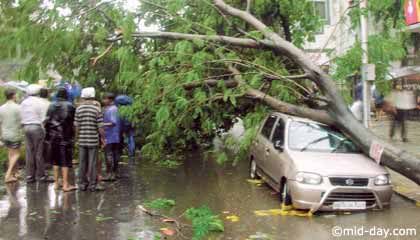
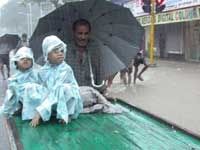
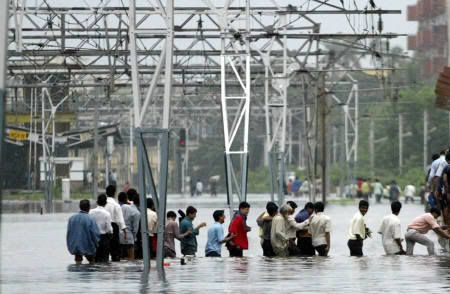
Nearly one-third of the state capital, Mumbai (Bombay), is under water.

Schools are closed and trading on the Bombay Stock Exchange has been light. The armed forces have been called in to take part in rescue efforts.

Image hosted by Photobucket.com

Villages inaccessible

Maharashtra's Chief Minister Vilasrao Deshmukh says it is now known that 99 people have been drowned or killed in mudslides in the state since heavy rain began on Sunday.

Image hosted by Photobucket.com

Nearly one-third of Mumbai is under water

Image hosted by Photobucket.com


Most of the deaths are reported in the Raigad and Ratnagiri districts. Twenty-two people are confirmed dead in Mumbai.

"We have not been able to reach some villages where more than several dozen people may be missing in landslides," Krishna Vatsa, the official in charge of the relief efforts, told Reuters news agency.

Image hosted by Photobucket.com

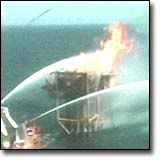
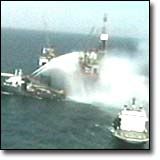
Major fire off Mumbai coast, ONGC platform destroyed.

Wednesday, July 27, 2005 (New Delhi, Mumbai):


A major fire has broken out at one of the oil platforms in Bombay High oil fields of Oil and Natural Gas Corporation (ONGC).

The fire broke out at the main oil processing platform of the Bombay High North field, which is connected to two other platforms.

According to initial reports, the platform has been completely destroyed in the fire which began at 4.30 pm (IST).

"We had a major accident. We don't have details as of now. We are assessing the damage," said Subir Raha, ONGC Chairman and MD.

The Coast Guard has rescued 150 ONGC employees from the site of the accident while 200 others are still stranded

Image hosted by Photobucket.com

Little information

However, there is little information available on casualty figures and possible damage as incessant rains in the area have snapped all communications links.

The cause of the fire at the platform, located some 160-km from Mumbai coast, is also not known yet.

Unconfirmed reports suggest that the fire was triggered after two oil rigs collided.

Sources say the plant where the accident occurred has the capacity to produce 50 lakh tonnes of crude oil per annum

Image hosted by Photobucket.com

cheers
vineet

Tuesday, July 12, 2005

London attacks
Image hosted by Photobucket.com


Introduction
Four explosions ripped across central London on Thursday 7 July, killing more than 50 people and injuring 700.
The co-ordinated attack hit three Underground trains and a bus, as the morning's rush hour drew to a close.
The capital's public transport system was halted and a high-level emergency procedure swung into action. All hospitals were full by mid-morning.
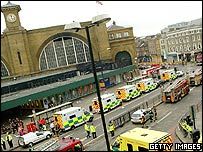
Image hosted by Photobucket.com
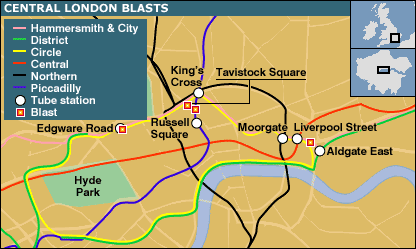
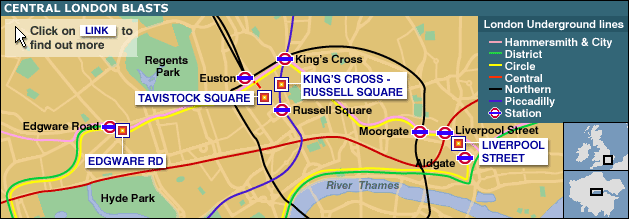
Three bombs went off almost simultaneously at about 0850 on Underground trains just outside Liverpool Street and Edgware Road stations, and on another travelling between King's Cross and Russell Square.
The final explosion was on a double-decker bus.
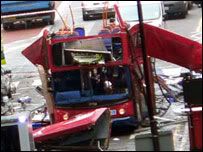
Image hosted by Photobucket.com

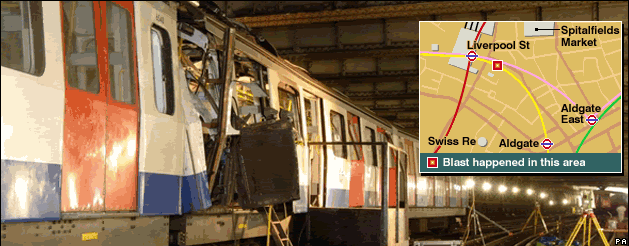
Liverpool Street
Image hosted by Photobucket.com
TIME: 0850
The explosion happened on a Circle line train between Liverpool Street station and Aldgate.
Police said on Friday that the device was placed on the floor of the third carriage.
Passenger Simon Tonkyn told of an "enormous bang and a lot of smoke". He added: "A group of us got fire extinguishers and were able to smash through the carriage door."
Another man, Terry O'Shea, said passengers were led down the track past the carriage where the explosion was. "We could see the roof was torn off it, and there were bodies on the track."
Passengers were led out of the train to safety at Liverpool Street station and Aldgate.
Once above ground, mobile phones stopped working, leaving people unable to contact relatives and friends.
Police have confirmed that seven people died in the blast. More than 100 were wounded, at least 10 seriously.

King's Cross - Russell Square

Image hosted by Photobucket.com

TIME: 0850
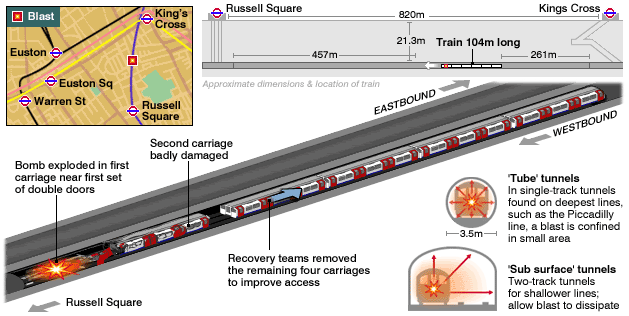
The explosion was on a Piccadilly line train travelling between King's Cross and Russell Square.
The device was in the first carriage by the first set of double doors where passengers stand, police said on Friday.

Recovery teams are still trying to extract all the bodies from the damaged carriages. Twenty-one people are confirmed dead but police expect that figure to rise.

The Piccadilly line is 21.3 metres (70 feet) deep at this point. Recovery teams face intense heat of up to 60C, dust, fumes, vermin, asbestos and there were initially concerns that the tunnel might collapse.

BBC News reporter Jacqui Head, who was on the train, told of a "massive bang" and added: "There was immediately smoke everywhere and it was very hot and everybody panicked. People started screaming and crying."
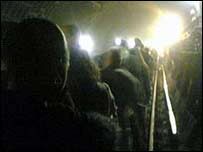
Image hosted by Photobucket.com

Edgware Road
Image hosted by Photobucket.com

Image hosted by Photobucket.com

TIME: 0850
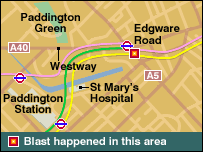
The blast was on a westbound Circle line Underground train, just leaving Edgware Road station for Paddington.
Police said on Friday that the device was on the floor of the second carriage, close to the first set of double doors.

After the blast passengers began emerging from the underground station, many covered in blood and clearly distraught. Paramedics went inside, prompting fears there may still be injured people trapped underground.

A woman passenger told the BBC there was a huge bang as two trains passed in a tunnel just outside Edgware Road. "All the lights went out and there was a lot of smoke."

It later emerged that the explosion on the train blew through a wall and hit another train on an adjoining line.

Police have confirmed that seven people died in the attack

Tavistock Square
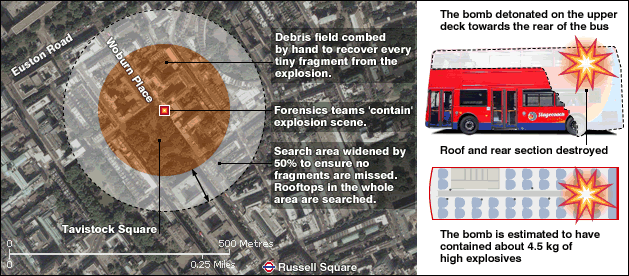
Image hosted by Photobucket.com

Image hosted by Photobucket.com

Image hosted by Photobucket.com

TIME: 0947
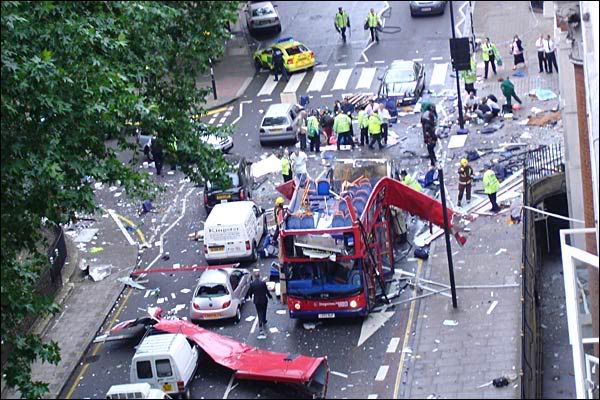
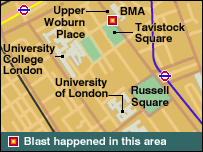
The blast tore through a double-decker bus at the junction of Tavistock Square and Upper Woburn place. The bus's roof was blown off and nearby cars were also damaged.
Police on Friday confirmed thirteen people had died.

One eyewitness described the bus as ripped to shreds - the result "carnage".

"It was a massive explosion and there were papers and half a bus flying through the air", said another.

The explosion happened outside the British Medical Association and doctors rushed from the building to perform triage and emergency care to those injured.

The bus was a number 30, travelling from Marble Arch to Hackney. It was following a diversion from its normal route.

Police said the device could have been placed on a seat or the floor.

They said there was no evidence to suggest it was carried on by a suicide bomber but they could not rule it out.
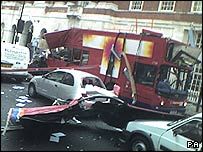
Image hosted by Photobucket.com

CHEERS!!!
VINEET

London blasts: Moroccan denies terror links
Image hosted by Photobucket.com

(Source: http://www.ndtv.com/template/template.asp?template=Terrorstrikes&slug=Moroccan+denies+terror+links&id=75842&callid=1")
Tuesday, July 12, 2005 (London):

A Moroccan dissident convicted in absentia in connection with the 2003 Casablanca terrorist attacks said he has no ties to militant Islamic groups.Mohamed al-Guerbouzi has also accused Moroccan intelligence of planting stories that he's a possible suspect in the London bombings. British media have reported that al-Guerbouzi was in hiding and that British investigators asked their European counterparts for information about him. Europol has refused to comment on the reports and Metropolitan Police haven't publicly named any suspects. "If I were in hiding where would I be talking to you from? The moon, the sky? I am on Earth," al-Guerbouzi said in a telephone interview in London yesterday, saying he was in the city. He was put in touch with AP by contacts who confirmed he was al-Guerbouzi. Murky linksAl-Guerbouzi refused a face-to-face interview unless he was paid, and he kept the telephone conversation brief. He spoke in classical Arabic with a slight Moroccan accent. The 44-year-old was convicted in absentia in Morocco in 2003 and sentenced to 20 years in prison in connection with the Casablanca bombings, which killed 32 bystanders at five targets hit by 13 suicide bombers. Morocco has demanded his extradition from Britain. French officials consider al-Guerbouzi, who has British and Moroccan nationality, to be the founder and principal recruiter of a Moroccan militant group, the Islamic Combatant Group. But al-Guerbouzi said he had no ties with any militant Islamic group. He accused Moroccan intelligence of trying to label him a militant. "I do not belong to any group whatsoever," said al-Guerbouzi. (AP)